Personal essay by Casey Hudek, Co-Director, Workers Confluence Fund
“Climate change brings together questions of human rights, health, safety, racial justice, and social justice in one shared struggle. It creates a frame for holding these conversations together, and it’s why unions are so important as conveners in this moment.”
I started 2026 with a lot of uncertainty—being part of union conversations about our role and how we show up in difficult times. Then, Operation Metro Surge escalated in Minneapolis just as I was grappling with questions about our strategies. Our Minnesota non-violent response to the federal ICE occupation brought an unexpected clarity, inspiration, and affirmation of what the role of unions has always been.
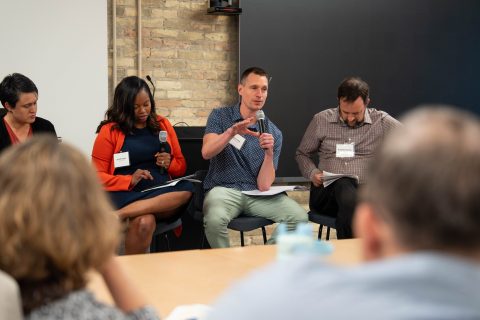
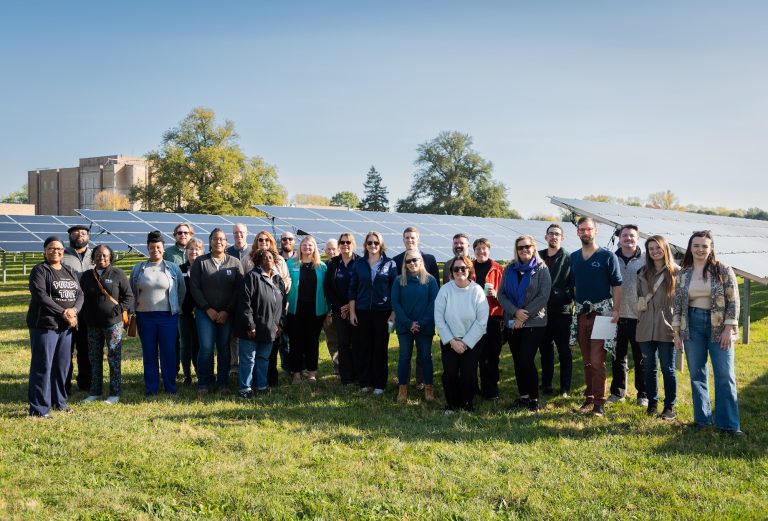
Casey Hudek, center, talks about the Workers Confluence Fund at an event.
I serve as Co-Director of the Workers Confluence Fund, a resource hub and strategy table dedicated to building worker power. We focus on strengthening partnerships between unions, community-based organizations, and philanthropy to support and organize workers in the most marginalized sectors of the economy—centering workers of color and advancing racial justice within the labor movement. Our work brings people and resources together: pooling funding, building organizational capacity, and supporting strategy development. We also convene a broader ecosystem grounded in shared struggle, where partners can confront growing attacks on workers and unions while developing proactive strategies.
I’ve always been interested in this intersection of union and community. I grew up on the east side of Madison, WI, in a working-class community. Both of my parents are lifelong organizers. Our house was often full of people meeting and strategizing for how to make our local community and beyond better and more just. It rooted in me an ethos of advocating for social change, as a normal part of life. My mom grew up poor, and she got involved in the women’s rights movement in New York when she was just 18. When I was young, she worked on gay rights, during the AIDS crisis. She raised me with a clear sense that, as a white, straight, middle-class man, I would move through the world with certain privileges—and that those privileges come with a responsibility to help right the scales and contribute to a more just world. At the same time, she was clear about how to do that work. Not from a place of guilt or saviorism, but by continually reorienting yourself—rolling up your sleeves and working alongside others as part of a shared struggle and collective fight.
In high school, my peer group was mostly young men of color, whose presence in my life deeply shaped my identity. Through them, I found belonging and friendship. I also witnessed stark injustices, both in the education system and in interactions with police. I was never in serious legal trouble, but I was a bit of a troublemaker and I was good at talking my way out. I remember being told, “Casey, if you can channel this, you will have real leadership potential.” What stayed with me, though, was watching my peers do many of the same things and face completely different outcomes. Over time, some of my closest friends were incarcerated, and some died. I saw firsthand the personal toll of systems designed to create justice that can instead produce harm—and how deeply society’s expectations can debilitate a person’s sense of self. It pushed me to ask bigger questions about systems, power, and what it takes to create change.
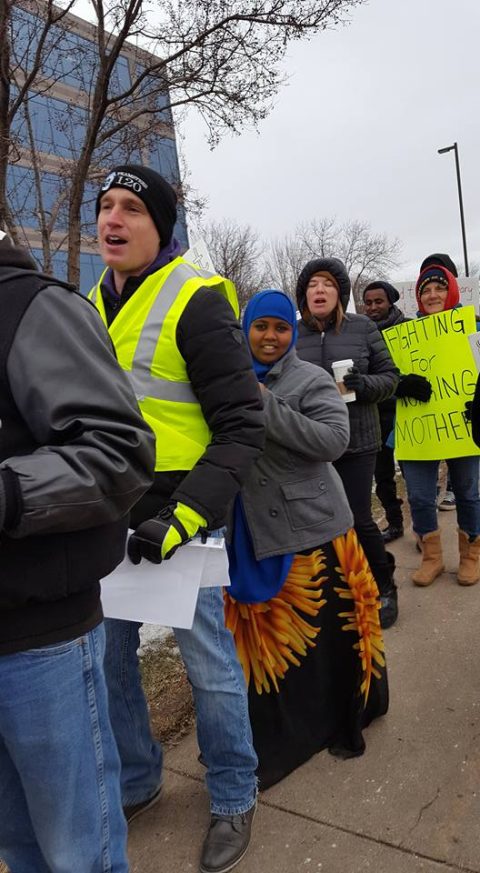
Casey organizing with working mothers in St. Cloud.
Over time, I found my way into organizing. I came to understand that people need real outlets to shape their own lives, to feel a sense of agency individually and in solidarity with others. For me, unions are one of those spaces, where workers can have a voice in their jobs, come together with their coworkers, and collectively shape how work happens.
Sitting with big questions is part of the work: What role do unions play in the broader fight for social change? How are they reckoning with their own shortcomings? And most importantly, how do we better center racial justice and immigrant rights as union issues? I’ve learned that much of these answers have to be anchored in listening, and the strength of relationships.
Most of the workers in the Workers Confluence network of campaigns are immigrants. A key part of our work is asking about lived experiences, listening closely to what people need to feel their rights and dignity are protected, and then strategizing about how we can meaningfully respond—even if that means thinking in new ways. In some cases, that includes coordinating immediate support, like connecting workers with an immigration attorney as soon as next week. This, too, is part of protecting workers, and it is concrete support we can provide. It has meant staying responsive, knowing we don’t have all the answers, and staying in conversation with others to develop strategy. This is where our organizing experience really comes into play: learning from union organizers in places like Chicago, who, during the federal immigration enforcement campaign there, Operation Midwest Blitz, paused all regular work to focus entirely on rapid response.
We are in a deeply intense and difficult moment for social justice. It has meant remaining ready when the landscape is so rapidly shifting. It raises even harder questions: What are we doing right now to help? Who do we need to be at this moment? And at the same time, how do we keep our gaze on the long game of building wealth, health, and stability for workers and their families? In thinking about climate change, we’ve had to hold a similar tension—being clear about what we are working toward and building for the long term, while also responding to the immediate and acute ways people’s survival is being impacted right now. We are building something much bigger than the moment we’re in, and we can’t lose sight of that. It’s a tension we have to learn to live with—and get comfortable navigating.
The union workforce is building the infrastructure needed for a clean energy economy. And for me, one of the core questions in this work is what it actually means to ensure a Just Transition—one where we bring everyone along. I think about the workers we represent who are in fossil fuel industries, many of whom are having some of the hardest conversations of their careers about climate change and what it means for their futures. I think about thousands of workers, many earning $150,000 or more, with highly specialized skills in coal and related industries—now facing deep uncertainty about what comes next. There was a time when we had a blind optimism in mainstream climate conversations, that fossil fuel jobs could simply translate into solar or other green energy jobs. But the reality is more complicated. Those new jobs don’t always match the same wages, stability, or ability to support a family.
With green banks, the Inflation Reduction Act (IRA), and other investments, there has been a more serious effort to grapple with that complexity. But we’re also in a very different landscape now, facing cuts to IRA funding, shrinking support for community benefit agreements, and slowed investment in electric vehicle infrastructure. From the outside, shutting down heavy industry can seem straightforward, but from the inside, it looks very different. These are often union, family-sustaining jobs, and in many cases, jobs held by workers of color rooted in local communities. These are tensions we have to stay in conversation about. Because at the end of the day, we need a Just Transition that works—not just in theory, but in practice. At our best, this is the role we can play as unions to build bridges.
Climate change brings together questions of human rights, health, safety, racial justice, and social justice in one shared struggle. It creates a frame for holding these conversations together, and it’s why unions are so important as conveners in this moment. Especially when these intersections are precisely what is being attacked.
Can we talk about data centers, mining in the Boundary Waters, and pipelines crossing Native lands—knowing there will be times when we deeply disagree and feel fragmented by the complexity of these issues? The question is how we stay in conversation: how we create space for dialogue that doesn’t shut down, that allows us to truly see one another, and helps us keep tending the tension of the hard but necessary conversations ahead.
“The question is how we stay in conversation: how we create space for dialogue that doesn’t shut down, that allows us to truly see one another, and helps us keep tending the tension of the hard but necessary conversations ahead.”
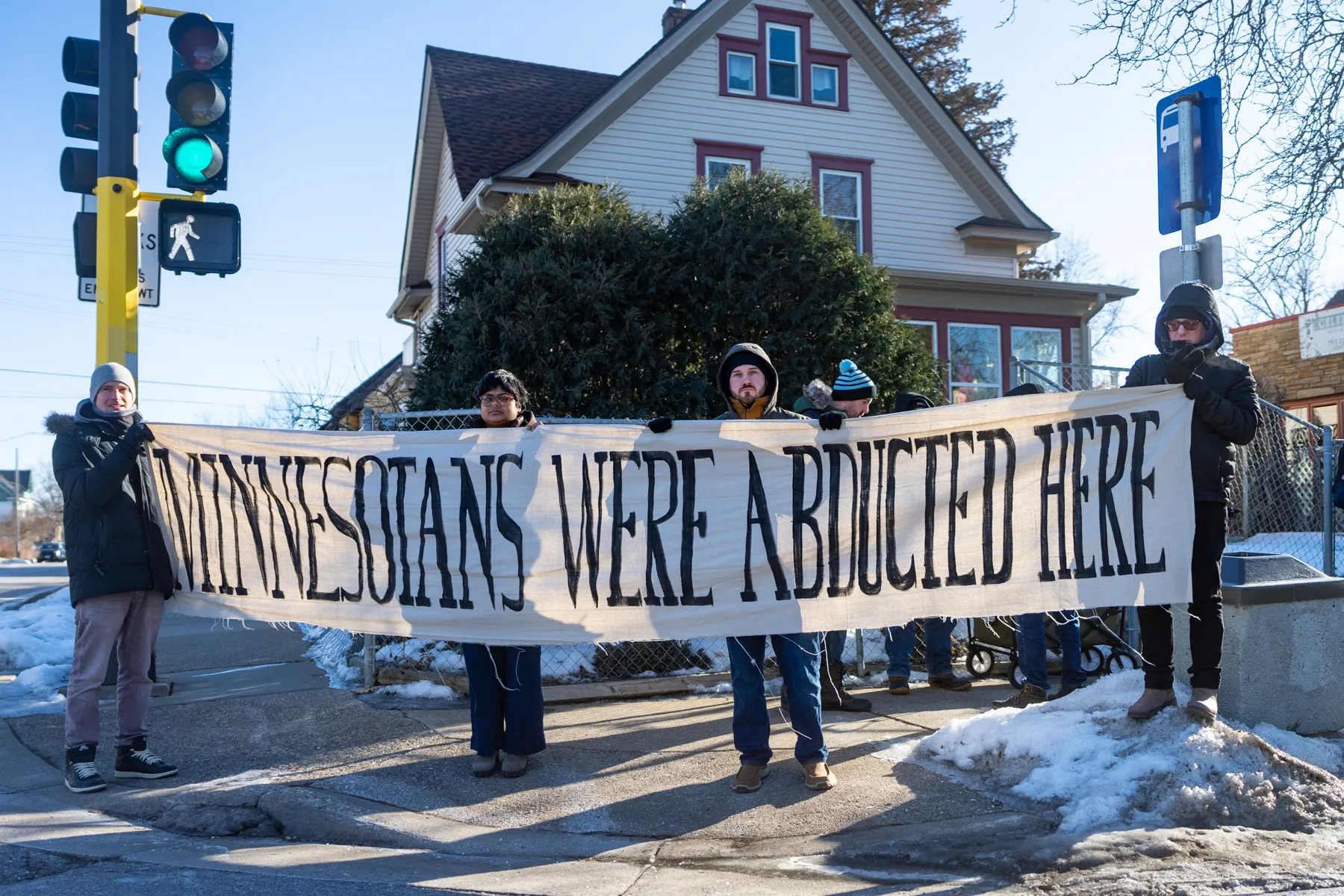
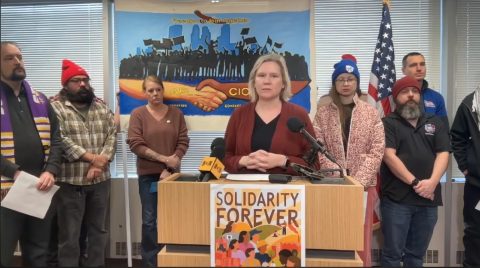
Casey with local union members, including Amalgamated Transit Union Local 1005, decrying federal agents detaining transit riders during Operation Metro Surge. Credit: Aaron Nesheim, Sahan Journal.
Operation Metro Surge brought a militarized presence through state sponsored violence, and it has been horrific and overwhelming to see our neighbors being violated, dehumanized, targeted, and detained. The intensity reached people’s doorsteps, forcing many of us to wrestle with questions of risk, responsibility, and what it means to stand up in real time. It’s been everyday people—putting themselves on the line, showing up for one another, and refusing to look away. At the same time, this moment has demanded attention on Minnesota—locally and globally—to witness some of the strongest expressions of organizing, education, and mutual aid in action.
There isn’t any one sector that can take credit. The power of our movement is that there is no one face, and it is leaderful. Which means we can tag-team, and take breaks while others tap in. Unions can play a key role in investing in the leadership development infrastructure, to help sustain the work, and make space for collective regeneration and visioning.
Amid ICE chaos, Minnesota unions came together in protest on January 23rd, 2026.
At the same time, I’ve been proud of how unions have shown up in this moment—sharing knowledge, drawing on histories of general strikes, and helping build toward efforts like the January 23, 2026, ICE Out of Minnesota: A Day of Truth & Freedom, a unified day of action where workers and everyday people withheld their labor and participated in boycotts to demonstrate collective power and demand justice. An estimated 38% of the state participated—making it the largest coordinated labor and community action in Minnesota’s recent history. Prior to that, the Minneapolis Teamsters Strike of 1934 stood as one of the most consequential labor actions in the state’s history. What we’re seeing now builds on that legacy. Movements learning from one another, carrying forward hard-earned lessons, and refining the strategies that make collective action possible, especially the hard work of seeing the throughlines, connections, and how our movements coalesce into shared mutuality.
Unions, in strategic alignment with worker centers and other community partners, are remembering who we are—who we have always been. Keeping ICE out of Minnesota businesses, off construction job sites, ensuring restaurants, and workplaces are places where workers are safe—is union work. At our core, this work is about humanizing workers, and securing a viable future, and that commitment is central to both our identity and our ability to be mobilized, and ready to do this work well. We have a renewed opportunity to anchor ourselves in this moment and build from it, and I am confident we can do it together.
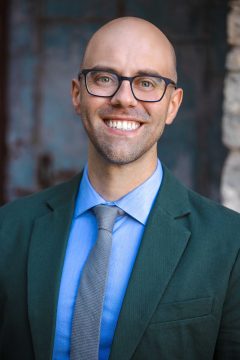
About the Author: Casey Hudek is the Co-Director of the Workers Confluence Fund, where he supports partnerships between unions and community organizations to build worker power and advance racial and economic justice.